
col-md-8 col-sm-8 col-xs-12 Katelyn Ehrhardt - Blog | Chabert Insurance: The Ehrhardt Agency
Skip to content
Click to Call
Chabert Insurance: The Ehrhardt Agency

240 Dalwill Dr, Suite B
Mandeville, LA 70471

Get Directions
Chabert Insurance: The Ehrhardt Agency

824 Elmwood Park Blvd, Suite 145
New Orleans, LA 70123

Get Directions
Chabert Insurance: The Ehrhardt Agency Blog

Can the Fortified Roof Program Lower Your Insurance Premium?

What Louisiana Homeowners Need to Know About the IBHS FORTIFIED Roof Standard

Louisiana homeowners are paying some of the highest insurance premiums in the country — and for many families across the Greater New Orleans area and the Northshore, the cost of coverage has become as significant a financial burden as the mortgage itself. The average annual homeowners insurance premium in Louisiana now stands at roughly $4,031 — more than $1,600 above the national average — and for coastal and near-coastal properties, that number can climb considerably higher.

Against that backdrop, one program has emerged as one of the most powerful tools available to Louisiana homeowners looking to meaningfully reduce their insurance costs: the FORTIFIED Roof program, administered by the Insurance Institute for Business and Home Safety (IBHS). At Chabert Insurance The Ehrhardt Agency, we talk to clients about FORTIFIED roofs regularly — because for the right home, it can be one of the smartest financial decisions a Louisiana homeowner can make.

This post will walk you through exactly what the FORTIFIED Roof program is, how it works, what the real savings look like, how to get a grant to help cover the cost, and what steps you need to take to put the discount to work on your policy.

What Is the FORTIFIED Roof Program?

FORTIFIED is a voluntary construction standard developed by the Insurance Institute for Business and Home Safety (IBHS) — an independent, nonprofit scientific research organization funded by the insurance industry. The FORTIFIED standard was created to address the specific weaknesses in residential roofing systems that cause the most damage during hurricanes, severe thunderstorms, and high-wind events.

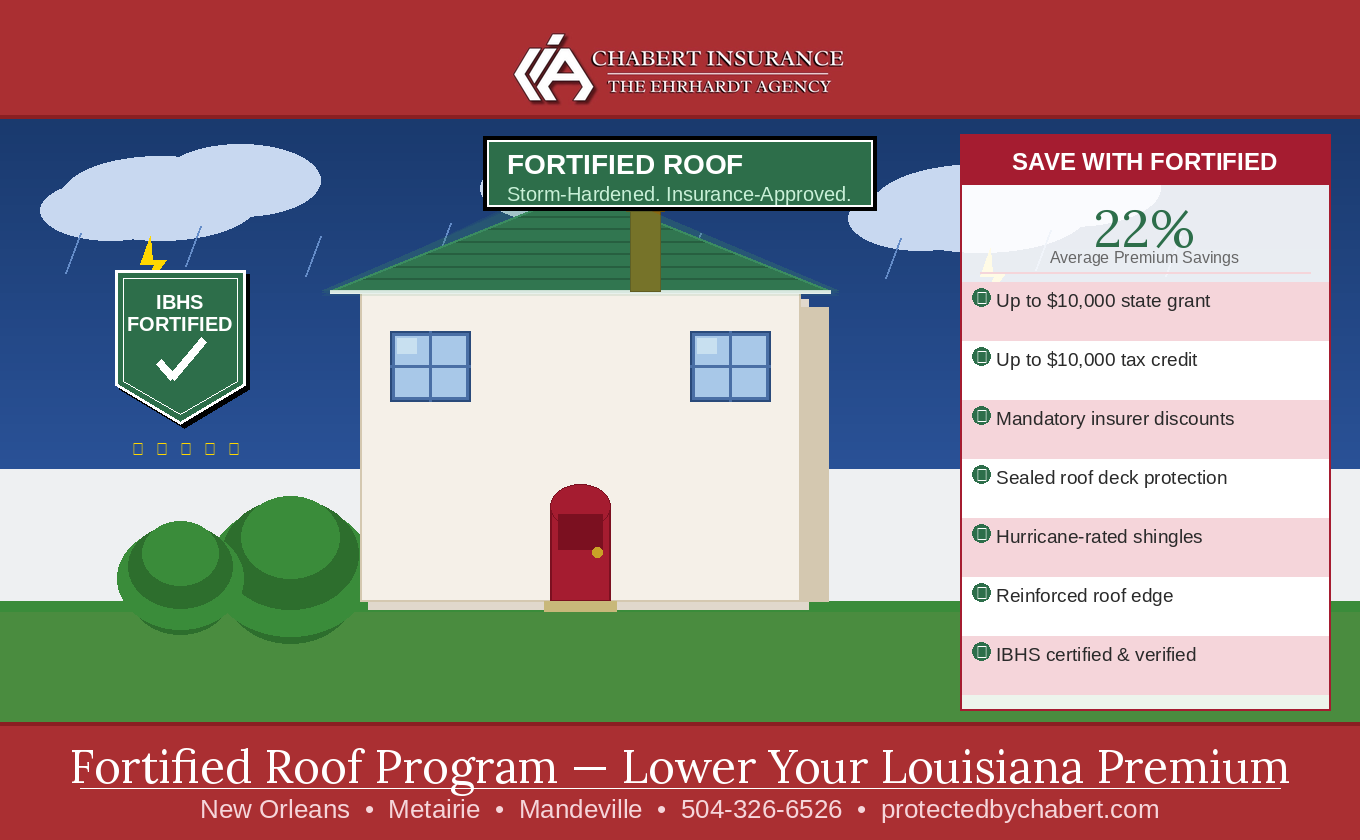
A FORTIFIED roof is not just a new roof. It is a roof built or retrofitted to a significantly higher standard than a typical replacement, using specific techniques and materials designed to dramatically improve wind resistance. The key components that distinguish a FORTIFIED roof from a standard roof include:

  • Sealed roof deck — A secondary water barrier is applied to the roof deck so that if shingles are lost in a storm, wind-driven rain cannot enter the home through the exposed decking.
  • Enhanced roof attachment — Ring-shank nails driven in a hurricane nailing pattern are used to secure roof decking more firmly to the underlying structure, reducing the risk of deck blow-off.
  • Reinforced roof edge — Enhanced edge flashing prevents the peel-back effect that commonly occurs when wind gets under the leading edge of a roof during a storm.
  • Impact-rated shingles — High-quality shingles designed to withstand significant hail impact are used, reducing the frequency of weather-related claims.

Once these standards are met and verified by an independent IBHS-certified evaluator, the homeowner receives an official IBHS FORTIFIED Roof certificate — the document that unlocks the insurance discounts and tax benefits that follow.

The Three Levels of FORTIFIED Designation

The FORTIFIED program has three designation levels, each representing a progressively higher standard of resilience. It is important to understand which level qualifies for Louisiana’s insurance discounts:

FORTIFIED Roof (Bronze)

This is the entry-level designation and the one that qualifies for Louisiana’s mandatory insurance discounts under Act 533 (2024). It focuses specifically on the roof — the most vulnerable component of a home in a hurricane — and is the most accessible and affordable starting point for most Louisiana homeowners. This is the designation the Louisiana Fortify Homes Program grant supports.

FORTIFIED Silver

Silver builds on the Roof designation by adding requirements for windows, doors, and attached structures. It provides broader protection against wind damage but is more involved and costly to achieve. Note that Louisiana’s current mandatory discount requirements apply specifically to the FORTIFIED Roof designation — Silver and Gold discounts vary by insurer.

FORTIFIED Gold

The Gold designation is the highest level, adding requirements for the entire structure including walls, foundation connections, and openings. It represents a comprehensively storm-hardened home but is typically pursued for new construction rather than retrofitting an existing home.

How Much Can a FORTIFIED Roof Actually Save You?

This is the question every homeowner asks — and the data from Louisiana is genuinely compelling.

According to a Louisiana Legislative Auditor report, the median homeowner who received a Louisiana Fortify Homes Program grant and installed a FORTIFIED roof saved $1,250 per year on their homeowners insurance — a reduction of approximately 22% in their annual premium. Their median premium dropped from $5,625 to $4,375 annually.

Other data from IBHS and the Louisiana Department of Insurance supports similar findings. Homeowners completing FORTIFIED projects statewide have seen premiums drop an average of 22%, with only about 3.3% of participants experiencing any increase. For many homeowners, the discount is applied primarily to the wind and hail portion of their premium — which is often the largest and fastest-growing component of a Louisiana homeowners policy.

Under Act 533, which took effect in 2024, all admitted insurers in Louisiana are now required by law to offer actuarially justified discounts to homeowners with a valid IBHS FORTIFIED Roof certificate. The Louisiana Department of Insurance issued Bulletin 2025-03 to reinforce this requirement, reminding all insurers and agents of their obligations and confirming that the IBHS FORTIFIED Certificate is the only documentation required to trigger the discount — no additional hurricane loss mitigation forms are needed.

The Real Numbers Median Louisiana homeowner annual premium:   $5,625 Median savings with a FORTIFIED Roof:         $1,250 per year (22%) Median post-FORTIFIED annual premium:         $4,375 Median FORTIFIED upgrade cost:                $16,229 After $10,000 grant (if eligible):            $6,229 out of pocket Payback period (after grant):                 Approximately 5 years Source: Louisiana Legislative Auditor Report

Louisiana’s FORTIFIED Roof Financial Incentives — A Complete Guide

Louisiana has built one of the most comprehensive support systems in the country for homeowners who want to upgrade to a FORTIFIED roof. Between state grants, federal grants, tax credits, and mandatory insurance discounts, the financial case for upgrading has never been stronger. Here is every incentive currently available:

IncentiveAmountWho QualifiesNotes
Louisiana Fortify Homes Program GrantUp to $10,000Owner-occupied primary residenceAwarded via lottery. First-come, first-served grant windows. Must have homestead exemption.
FORTIFIED Fund Grant (FHLB)Up to $15,000Income at or below 80% of Area Median IncomeContact FORTIFIEDfund@fhlb.com. Helps lower-income homeowners offset costs.
CDBG GrantsUp to $35,000Income at or below 80% AMIOperated with Rebuilding Together New Orleans. Call 504-264-1815.
Louisiana Income Tax CreditUp to $10,000Primary residence with homestead exemptionFor IBHS-certified FORTIFIED roof installations after July 1, 2025. Subject to $10M annual cap.
Construction Code Retrofitting Deduction50% of cost, up to $10,000Primary residence (not rental)Deduction on Louisiana income taxes. Effective for taxable periods beginning Jan 1, 2026.
Insurance Premium Discount22% avg savingsAll eligible homeowners with IBHS certificateApplied to wind/hail portion of premium. Required by law under Act 533 (2024).

The Louisiana Fortify Homes Program — How the Grant Works

The Louisiana Fortify Homes Program (LFHP) is the state’s flagship grant program, offering up to $10,000 to eligible homeowners to upgrade to a FORTIFIED roof. Here is how the process works:

  1. Confirm eligibility — Your home must be your primary residence and you must claim the Louisiana homestead exemption on the property.
  2. Watch for application windows — The LFHP grant lottery opens periodically throughout the year. Spots fill quickly — sometimes within hours. Set a reminder and have your documents ready before the window opens.
  3. Apply — You will need your homestead exemption tax bill, driver’s license, homeowners insurance declarations page, and flood policy (if applicable). Upload everything at the time of application.
  4. Lottery selection — If selected, schedule your on-site inspection with a FORTIFIED evaluator within 15 days.
  5. Choose a FORTIFIED contractor — Only contractors on the Louisiana Fortify Homes roster can access grant funds directly. Get at least three bids and confirm the lead installer holds a current FORTIFIED Roofer credential.
  6. Complete the installation — The IBHS evaluator returns to certify the completed work meets FORTIFIED standards.
  7. Receive your IBHS certificate — Upload it to your portal, provide it to your insurance agent, and request the discount at your next renewal.
  8. Apply for the state income tax credit — For installations completed after July 1, 2025, you may be eligible for a nonrefundable tax credit of up to $10,000. Subject to a $10M annual statewide cap on a first-come, first-served basis.
Important Grant Timing Note As of late 2025, Louisiana has reached a milestone of over 10,000 FORTIFIED roofs installed statewide, with over 4,000 supported by the Louisiana Fortify Homes Program. An additional 1,300 awards were pending as of December 2025. The program has ongoing state funding — $5 million annually from surplus lines taxes and additional budget appropriations — so new grant rounds are expected to continue. Contact your agent or visit the Louisiana Department of Insurance website to monitor upcoming application windows. Even if a grant window is not currently open, you can begin the FORTIFIED upgrade process now and apply for reimbursement or the next available window when it opens.

Is Your Home a Good Candidate for a FORTIFIED Roof?

Not every home in Southeast Louisiana will have the same return on investment for a FORTIFIED upgrade — but many will. Here are the factors that make a home a particularly strong candidate:

  • Your current roof is aging or approaching replacement age — If you need a new roof anyway, the incremental cost to upgrade to FORTIFIED standards is significantly lower than doing a FORTIFIED retrofit on an otherwise new roof.
  • You are in a coastal or near-coastal parish — Homes in Orleans, Jefferson, St. Tammany, St. Charles, Plaquemines, and surrounding parishes face the highest wind risk and typically see the most dramatic premium reductions from FORTIFIED certification.
  • Your premium is high — If you are paying significantly above-average premiums, the percentage savings from FORTIFIED are applied to a larger base, meaning your dollar savings are greater.
  • Your carrier is admitted in Louisiana — All admitted Louisiana insurers are now required by law to offer FORTIFIED discounts. If your carrier is a surplus lines or non-admitted market, confirm whether the discount applies before committing to the upgrade.
  • You are buying a home — If you are purchasing a home, a seller who has already completed a FORTIFIED upgrade is offering you built-in savings from day one. Ask your agent about the IBHS certification status of any home you are considering.

What to Do After You Get Your FORTIFIED Certificate

Getting the IBHS FORTIFIED Roof certificate is only half the job. The other half is making sure your insurance policy reflects the discount you are entitled to. Here is what to do:

  • Contact your insurance agent immediately after receiving your IBHS certificate. The certificate is the only document required — per Louisiana Department of Insurance Bulletin 2025-03, no additional hurricane loss mitigation forms should be required.
  • Request a premium recalculation at your next renewal — or ask whether you can receive a pro-rated discount mid-term.
  • Ask specifically where the discount is being applied — most insurers apply it to the wind and hail portion of your premium. Ask for a premium calculation worksheet showing how the credit is applied.
  • If your insurer does not apply the discount or you believe it is being applied incorrectly, contact the Louisiana Department of Insurance at 1-800-259-5300 or visit ldi.la.gov.
  • Keep a copy of your certificate in a safe place — digital and physical. You may need it at renewal, when you sell the home, or if you switch carriers.

Louisiana Is Leading the Nation — and It Is Making a Difference

Louisiana is the fastest-growing FORTIFIED market in the country. What started with fewer than 320 IBHS-certified roofs in 2023 has grown to over 10,000 completed installations statewide, with the Greater New Orleans region accounting for a significant share — over 4,000 installations supported by the state program alone.

The top three parishes in terms of total FORTIFIED activity are Jefferson, Orleans, and St. Tammany — the exact communities where Chabert Insurance The Ehrhardt Agency serves clients every day. This is not a distant program or a theoretical discount. It is happening in your neighborhood, and your neighbors are already benefiting from it.

The state’s investment is substantial — $30 million appropriated in 2023, $20 million more in 2024, $15 million in 2025, and now a permanent annual funding stream established through Act 79. Louisiana has committed to making FORTIFIED roofs a cornerstone of its long-term insurance market reform strategy. And under the proposed Regulation 136, the Department of Insurance is moving to standardize and potentially enlarge FORTIFIED discounts even further — making the program even more financially compelling for homeowners who act sooner rather than later.

A Note from Chabert Insurance We know Louisiana’s insurance market is expensive and complicated — and we know that real solutions are hard to find. The FORTIFIED Roof program is one of the few genuine win-win opportunities available to Louisiana homeowners right now. If you are curious whether a FORTIFIED upgrade makes sense for your home, call us. We can walk you through your current policy, help you understand how much your premium could decrease, and make sure you get every dollar of credit you are entitled to once you complete the upgrade. This is exactly the kind of guidance we are here to provide.
Want to Know If a FORTIFIED Roof Could Lower Your Premium? Chabert Insurance The Ehrhardt Agency serves homeowners across New Orleans, Metairie, Mandeville, Covington, and all of Southeast Louisiana. Call us today — we will review your current policy and help you understand exactly what a FORTIFIED Roof could save you. 📞 Call or Text: 504-326-6526 🌐 Visit: protectedbychabert.com 📍 Mandeville & New Orleans, Louisiana

First-Time Homebuyer’s Guide to Home Insurance in Louisiana

Buying your first home is one of the most exciting milestones of your life. It is also one of the most overwhelming — and in Louisiana, that process comes with a layer of complexity that first-time buyers in other states simply do not face. Between a challenging insurance market, mandatory flood coverage requirements, hurricane season, and a carrier landscape unlike anywhere else in the country, navigating home insurance as a new Louisiana homeowner can feel like learning a foreign language overnight.

At Chabert Insurance The Ehrhardt Agency, we work with first-time homebuyers across the Greater New Orleans area and the Northshore every single week. We know the questions you are asking, the surprises that catch buyers off guard, and the mistakes that are easy to avoid if you know what to look for. This guide is designed to walk you through everything you need to know — before you close, before you sign, and before you make a decision you will regret.

Why Home Insurance in Louisiana Is Different

Let’s start with the honest truth: homeowners insurance in Louisiana is more expensive, more complicated, and harder to get than in most other states. The average cost of homeowners insurance in Louisiana is approximately $2,835 per year — about 32% higher than the national average. For many first-time buyers, this comes as a significant shock, especially when the insurance cost is not factored into their original budget.

The reasons behind these higher costs are deeply rooted in Louisiana’s geography and history. The state sits in the direct path of Gulf Coast hurricanes, its coastal land is disappearing at one of the fastest rates in the world, much of the Greater New Orleans area sits below sea level, and the state has experienced more catastrophic flood losses than almost anywhere else in the country. Since hurricanes Katrina and Ida, dozens of national insurance carriers have reduced their presence in Louisiana or exited the market entirely, leaving fewer options and higher prices for homeowners.

Understanding this context before you start shopping for a home will help you budget accurately, ask better questions, and make smarter decisions throughout the homebuying process.

When Do You Need Home Insurance — and Why Your Lender Requires It?

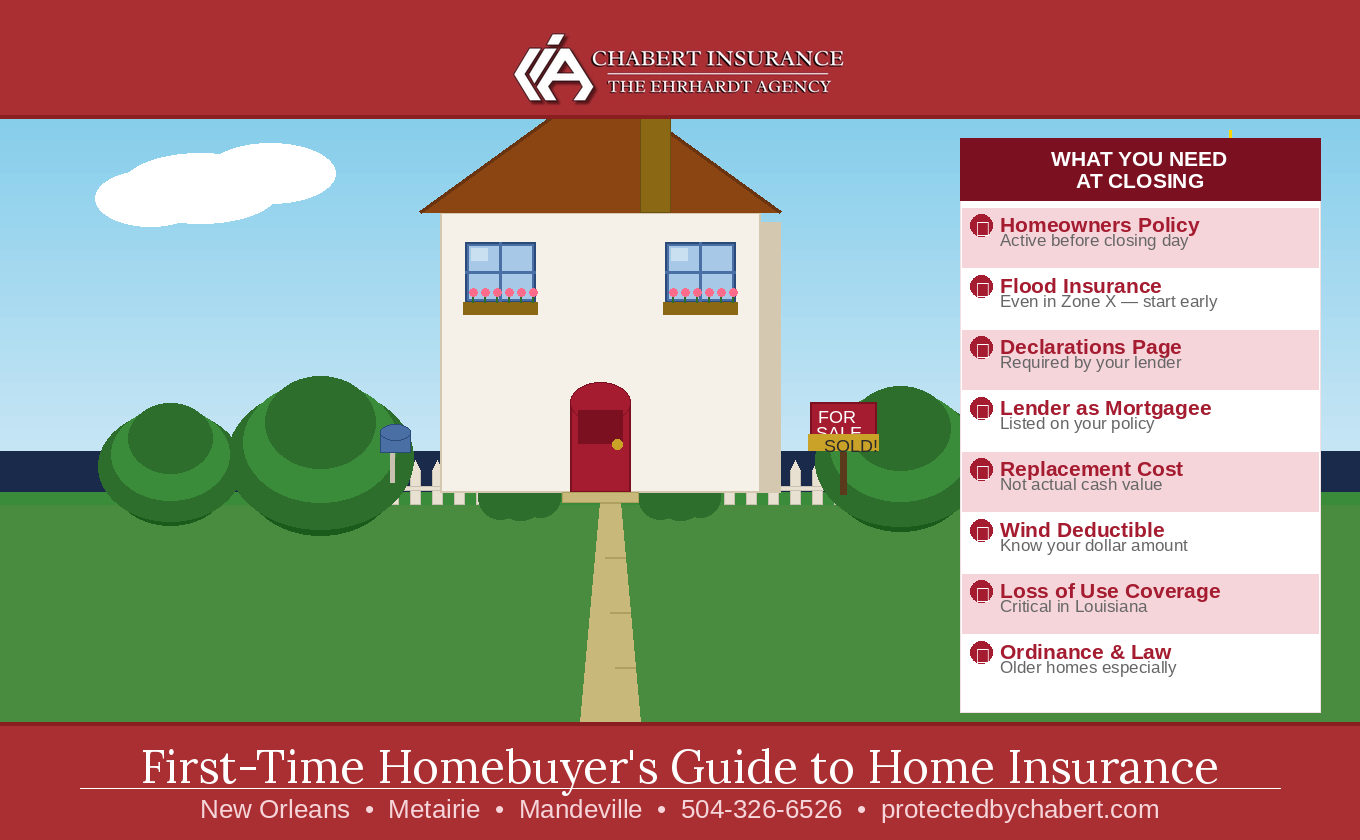
If you are financing your home purchase with a mortgage — which most first-time buyers do — your lender will require you to have an active homeowners insurance policy in place before you can close. This is not optional. Without proof of insurance, your closing will not happen.

The reason lenders require this is straightforward: your home is the collateral for your loan. If your home burns down or is destroyed by a hurricane, the lender wants to know that the asset securing their investment is protected. The insurance policy protects both you and the bank.

Most lenders will require you to provide a declarations page — a one-page summary of your policy details — before closing. Your lender will also typically require that they be listed on the policy as an Additional Insured or Mortgagee, meaning they receive notice if your policy lapses or is cancelled. This is standard practice and nothing to be alarmed by.

Start Early Do not wait until the week before closing to start shopping for home insurance. In Louisiana’s complicated market, getting quotes, comparing options, and binding a policy can take longer than you expect. We recommend starting the insurance conversation at least 30-45 days before your expected closing date — ideally as soon as your offer is accepted.

Understanding What a Homeowners Policy Actually Covers

A standard homeowners insurance policy is made up of several coverage components. Understanding each one — and how it applies specifically to Louisiana — is essential for making sure your policy is truly protecting you.

Coverage TypeWhat It CoversLouisiana Importance
Dwelling (Coverage A)The structure of your home — walls, roof, floors, built-in appliances.Critical — rebuild costs in Louisiana are high due to storm damage demand.
Other Structures (Coverage B)Detached garage, fence, shed, carport.Often overlooked but important for Louisiana properties.
Personal Property (Coverage C)Furniture, electronics, clothing, and belongings inside the home.Make sure limits are adequate — contents claims are very common after storms.
Loss of Use (Coverage D)Pays for hotel, meals, and living expenses if your home is uninhabitable.Essential in Louisiana — hurricane and flood damage can displace families for months.
Liability (Coverage E)Protects you if someone is injured on your property.Important for pools, trampolines, and high-traffic properties.
Medical Payments (Coverage F)Pays medical bills for guests injured on your property regardless of fault.Provides a layer of protection before liability claims escalate.

The Louisiana-Specific Coverages Every First-Time Buyer Needs to Understand

Beyond the standard components of a homeowners policy, there are several Louisiana-specific coverage issues that every first-time buyer needs to understand before purchasing a home in our market.

1. Flood Insurance — The Most Critical Conversation

Your homeowners policy does not cover flood damage. This is one of the most important things to understand as a first-time buyer in Louisiana. Flood insurance is an entirely separate policy that must be purchased independently — either through the National Flood Insurance Program (NFIP) or through a private flood carrier.

If your home is in a high-risk flood zone (Zone A, AE, V, or VE) and you have a federally backed mortgage, flood insurance is legally required. But even if your home is in a lower-risk Zone X designation, we strongly recommend purchasing flood coverage. Nationally, about 25% of all flood insurance claims come from properties outside of high-risk zones — and in a state like Louisiana, that risk is even more real.

There is also a critical timing issue: NFIP flood policies have a standard 30-day waiting period before they go into effect. If you wait until a storm is approaching or named, it is too late. Get your flood policy in place at closing — or ideally, before.

2. Wind and Hail Deductibles — Know Your Number Before You Close

In Louisiana, most homeowners policies include a separate, higher deductible that applies specifically to wind and hail damage — the type of damage most commonly associated with hurricanes. This deductible is typically expressed as a percentage of your home’s insured value rather than a flat dollar amount.

On a $300,000 home, a 2% wind deductible means you would pay $6,000 out of pocket before insurance kicks in for wind damage. A 5% deductible means $15,000. As a first-time buyer, make sure you know exactly what your wind deductible is before you bind the policy — and make sure you have sufficient savings to cover it if a storm hits.

3. Replacement Cost vs. Actual Cash Value

When your home or belongings are damaged, how your policy pays out makes an enormous difference. There are two primary methods:

  • Replacement Cost Value (RCV) — Pays what it actually costs to repair or replace the damaged item at today’s prices. This is the coverage you want.
  • Actual Cash Value (ACV) — Pays the depreciated value of the item, accounting for age and wear. On a 15-year-old roof, this could pay out a fraction of what a new roof actually costs.

In Louisiana, where construction costs have risen significantly since recent storms, the gap between ACV and RCV payouts can be staggering. Always confirm that your dwelling coverage is written on a Replacement Cost basis — and ask specifically whether your personal property coverage is RCV or ACV as well.

4. Ordinance or Law Coverage

Louisiana has significant building code requirements that have been updated substantially since older homes were constructed. If your home is damaged and local codes require you to bring the entire structure up to current standards during the repair — not just fix the damaged portion — Ordinance or Law coverage pays for that additional cost. Without it, you could face tens of thousands of dollars in unexpected expenses that your standard policy will not cover. This is especially important for buyers purchasing older homes in New Orleans, Metairie, and other historic neighborhoods.

5. Loss of Use Coverage — More Important Than You Think

If your home becomes uninhabitable after a covered event — whether it is a hurricane, fire, or major water damage — Loss of Use coverage pays for your temporary living expenses. This includes hotel stays, restaurant meals, and other costs above what you normally spend. In Louisiana, where major storm damage can displace families for months or even years, having adequate Loss of Use limits is not a luxury — it is a necessity. Review your policy’s Loss of Use limits carefully and make sure they reflect the realistic cost of alternative housing in your area.

How Much Home Insurance Do You Actually Need?

One of the most common mistakes first-time buyers make is insuring their home for the purchase price rather than the rebuild cost. These are two very different numbers.

The purchase price of a home includes the value of the land — which cannot be destroyed in a storm. What your insurance needs to cover is the cost to completely rebuild the structure from the ground up if it were totally destroyed. In Louisiana, rebuild costs have increased significantly due to material and labor costs driven by post-storm demand across the Gulf Coast.

Your insurance agent can help you run a replacement cost estimator to determine the appropriate dwelling coverage amount for your specific home. Do not simply accept the minimum coverage your lender requires — that number is based on the outstanding loan balance, not the actual cost to rebuild your home. Make sure the two align or that you are fully aware of the gap.

The Louisiana Insurance Market — What First-Time Buyers Need to Know

Louisiana’s homeowners insurance market is unlike any other in the country. Since hurricanes Katrina, Gustav, Ike, Laura, Delta, Zeta, and Ida, the carrier landscape has been fundamentally reshaped. Many national carriers have significantly reduced their appetite for new Louisiana business, exited the state entirely, or non-renewed large portions of their books.

This means that as a first-time buyer, you may find that your options are more limited — and more expensive — than you expected. It also means that working with an independent insurance agent who knows the Louisiana market is more valuable than ever. Unlike a captive agent who can only offer products from one carrier, an independent agent like Chabert Insurance The Ehrhardt Agency shops across multiple carriers — including admitted carriers, surplus lines markets, and specialty programs — to find the best available option for your specific home.

There are also things you can do before you purchase a home to improve your insurability and reduce your costs:

  • Ask about the home’s claims history — a property with multiple prior claims may be difficult or expensive to insure.
  • Check the condition of the roof — most carriers will not write a policy on a roof over 20 years old, and some have stricter cutoffs.
  • Ask about the home’s elevation certificate if it is in or near a flood zone — this document can significantly affect your flood insurance premium.
  • Look into the Fortified Home program — a Louisiana-specific construction standard that can qualify your home for premium discounts.

First-Time Homebuyer Programs in Louisiana — Don’t Overlook These

Louisiana has several programs specifically designed to help first-time buyers — and some of them can help offset your insurance and closing costs. Here are the most important ones to know about:

Louisiana Housing Corporation (LHC) Programs

The LHC offers several mortgage programs for first-time buyers, including the MRB Home program for buyers earning 80% or less of the area median income, which offers below-market interest rates and between 5-9% of the mortgage amount in down payment and closing cost assistance. The MRB Assisted program serves buyers in targeted areas earning up to 140% of AMI.

New Orleans Direct Homebuyer Assistance Program

The City of New Orleans offers eligible first-time buyers up to $55,000 as a forgivable soft second mortgage for down payment assistance, plus $5,000 in closing cost assistance. The program is income-limited (80% of AMI for the area) and the home must be priced at $324,000 or below. The assistance is forgivable after 10 years.

Jefferson Parish First-Time Homebuyer Assistance

Jefferson Parish offers eligible first-time buyers up to $50,000 (or $60,000 in Kenner) as a forgivable loan for down payment and closing cost assistance. Like the New Orleans program, income limits and purchase price caps apply.

These programs can make a meaningful difference in your ability to afford both your down payment and your first year of insurance premiums. Ask your lender and your insurance agent about all available options early in the process.

Your Home Insurance Checklist Before Closing

Here is a simple checklist every first-time buyer in Louisiana should work through before closing day:

  • Start shopping for homeowners insurance at least 30-45 days before your expected closing date.
  • Work with an independent agent who can compare multiple carriers — not just one company.
  • Confirm your dwelling coverage is based on replacement cost, not purchase price.
  • Ask specifically about your wind and hail deductible — and make sure you understand the dollar amount.
  • Purchase a flood insurance policy at closing — even if you are not in a high-risk zone.
  • Ask about Ordinance or Law coverage, especially if buying an older home.
  • Review your Loss of Use coverage limits — make sure they are adequate for Louisiana housing costs.
  • Get a copy of the home’s prior claims history (your agent can help with this).
  • Ask about the roof age and condition before closing — this affects your coverage options and premium.
  • If the home is in or near a flood zone, ask for an elevation certificate.
  • Confirm your lender is listed as the Mortgagee on your homeowners policy before closing.
  • Keep a copy of your declarations page in a safe place — digital and physical.
A Note from Chabert Insurance We know the Louisiana insurance market is frustrating — especially for first-time buyers who are already managing so many moving parts. Our job is to take that burden off your plate. We will shop your coverage, explain your options in plain language, make sure your policy meets your lender’s requirements, and make sure you are genuinely protected — not just checking a box. Call or text us at 504-326-6526. We are here to help.
Buying Your First Home in Louisiana? Let Chabert Insurance The Ehrhardt Agency walk you through your options and make sure you are properly protected from day one. We serve first-time buyers across New Orleans, Metairie, Mandeville, Covington, Slidell, and all of Southeast Louisiana. 📞 Call or Text: 504-326-6526 🌐 Visit: protectedbychabert.com 📍 Mandeville & New Orleans, Louisiana

FEMA Flood Zones in New Orleans — What Homeowners Need to Know

If you own a home in the Greater New Orleans area or on the Northshore, there is a number attached to your property that affects your mortgage, your insurance premium, and your financial exposure to one of the most common disasters in Louisiana. That number — or more accurately, that letter — is your FEMA flood zone designation.

And yet, most Louisiana homeowners have no idea what their flood zone actually means, how it was determined, or why it matters so much. At Chabert Insurance The Ehrhardt Agency, we talk about flood zones with clients every single day. So let’s clear it up once and for all.

What Is a FEMA Flood Map?

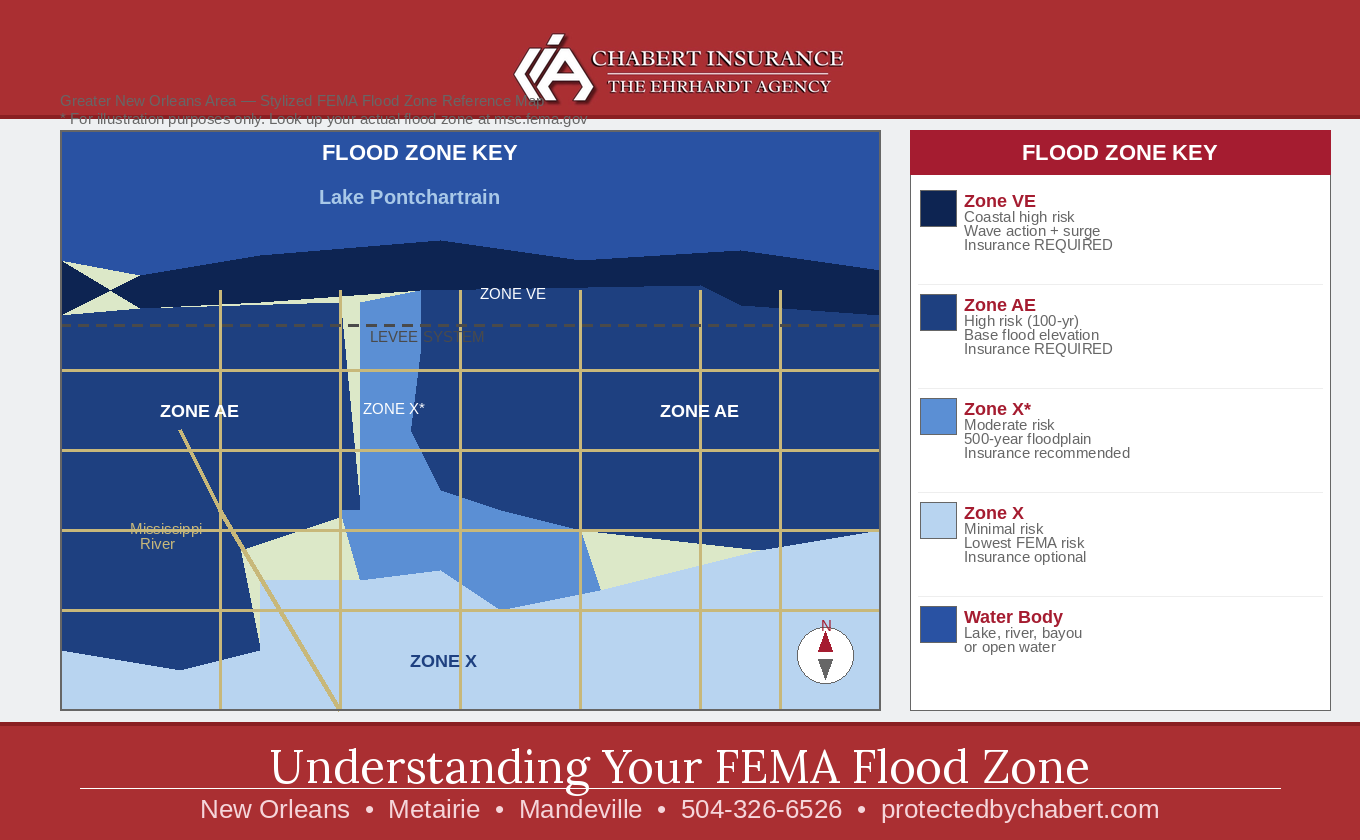
FEMA’s Flood Insurance Rate Maps — known as FIRMs — are the official government maps that show the flood risk for every piece of land in the country. These maps are created using detailed engineering studies, historical flood data, elevation surveys, storm modeling, and drainage analysis.

The maps divide land into flood zones based on the statistical probability of flooding in any given year. Your flood zone designation tells lenders, insurers, and local governments how likely your property is to flood — and at what level.

In Southeast Louisiana, FEMA flood maps cover Orleans Parish, Jefferson Parish, St. Tammany Parish, St. Charles Parish, St. Bernard Parish, and the surrounding areas. The maps are updated periodically as new data becomes available, new levees are built, and development patterns change across the region.

You can look up your property’s official flood zone designation at FEMA’s Flood Map Service Center at msc.fema.gov — just enter your address and your Flood Insurance Rate Map will pull up.

Breaking Down the Flood Zone Designations

Here is what each flood zone designation actually means for homeowners in the New Orleans metro area and Northshore:

ZoneWhat It MeansFlood Insurance Required?
Zone AEHigh-risk zone. Has a 1% annual chance of flooding (the ‘100-year flood’). Base Flood Elevations are established.Yes — required for federally backed mortgages
Zone AHigh-risk zone. 1% annual chance of flooding but no Base Flood Elevation established.Yes — required for federally backed mortgages
Zone VE / VCoastal high-risk zone subject to wave action in addition to flooding. Most severe designation.Yes — required for federally backed mortgages
Zone X (Shaded)Moderate risk. 0.2% annual chance of flooding (the ‘500-year flood’). Between the 100-year and 500-year floodplain.Not required — but strongly recommended
Zone X (Unshaded)Minimal risk area. Outside the 500-year floodplain. Considered low risk.Not required — but still possible to flood

The ‘100-Year Flood’ — The Most Misunderstood Term in Insurance

When you hear that a property is in the ‘100-year floodplain,’ most people assume it means the area only floods once every hundred years. That is one of the most dangerous misconceptions in the insurance world — and in Louisiana, it can cost you everything.

The 100-year flood designation does not mean a flood happens once a century. It means there is a 1% chance of a flood of that magnitude occurring in any given year. That may sound small, but consider this: over the course of a 30-year mortgage, a home in the 100-year floodplain has roughly a 26% chance of experiencing a flood event.

In Louisiana, where major storms arrive with regularity and drainage infrastructure is constantly tested, the statistical risk is even more meaningful than those numbers suggest. Orleans and Jefferson Parishes have among the highest concentrations of repetitive flood loss properties in the entire country — properties that have flooded not once, not twice, but multiple times.

Being Outside a Flood Zone Does Not Mean You Are Safe

This is perhaps the most important point we make to homeowners across the Northshore and Greater New Orleans area: being outside a high-risk flood zone does not mean your home cannot flood. It simply means FEMA has determined the statistical probability is lower.

The data backs this up clearly. Nationally, roughly 25% of all flood insurance claims are filed by properties located outside of high-risk flood zones. In a state like Louisiana — where heavy rainfall events, overwhelmed drainage systems, and hurricane storm surge routinely affect neighborhoods well outside mapped floodplains — that number is especially relevant.

Think about the flooding that occurred across the Northshore during the August 2016 flood event. Tens of thousands of homes in St. Tammany Parish and surrounding areas flooded — many of them in Zone X, where flood insurance was not required and many homeowners did not have it. The damage was catastrophic precisely because so many people assumed they were safe.

The Hard Truth Being in Zone X or outside a mapped flood zone is not a guarantee that your home will not flood. It is a statistical designation based on modeling — not a promise. Every home in Southeast Louisiana has some level of flood risk. The only question is whether you are financially prepared if it happens.

How Flood Zone Designations Affect Your Insurance and Mortgage

Your flood zone designation has direct, real-world financial consequences. Here is how it affects you:

Federally Backed Mortgages

If your home is in a high-risk flood zone (Zone A, AE, V, or VE) and you have a mortgage backed by a federal lender — which includes most conventional mortgages — you are legally required to carry flood insurance. Your lender will verify this at closing and every year thereafter. If you let your flood policy lapse, your lender can force-place coverage on your behalf, which is almost always far more expensive than purchasing it yourself.

Insurance Premiums

Your flood zone designation is one of the primary factors that determines your flood insurance premium. Properties in Zone AE or VE will typically carry higher premiums than those in Zone X. However, since FEMA introduced Risk Rating 2.0 in 2021 and 2022, flood insurance pricing has shifted to reflect each property’s individual risk characteristics — including elevation, distance from water, and foundation type — rather than relying solely on flood zone designation.

This means that some Zone X properties have seen premium increases under the new system, while some Zone AE properties have seen decreases, depending on their specific risk profile.

Home Sales and Purchases

When you buy or sell a home in Louisiana, the flood zone designation plays a significant role. Buyers in high-risk zones must factor the cost of mandatory flood insurance into their monthly housing budget. Sellers in high-risk zones are required to disclose the property’s flood zone status. And when a property is remapped from a lower-risk zone to a higher-risk zone, it can affect the home’s marketability and value.

What Are FEMA Map Updates — and Why Should You Pay Attention?

FEMA periodically revises flood maps to account for new data, infrastructure changes, and updated storm modeling. In recent years, Southeast Louisiana has seen significant map revisions affecting Orleans, Jefferson, St. Tammany, and St. Charles Parishes — with expanded AE zones in some areas and revised V zones near Lake Pontchartrain reflecting updated wave and surge modeling.

When a map update places your property in a higher-risk zone, it can trigger mandatory flood insurance requirements and affect your premium. When a map update moves your property to a lower-risk zone, you may have the opportunity to reduce your premium or adjust your coverage.

The key takeaway: your flood zone designation today may not be your flood zone designation in five years. Staying informed about map updates in your parish is an important part of managing your risk and your insurance costs as a Louisiana homeowner.

NFIP vs. Private Flood Insurance — Which Is Right for You?

Most flood insurance in Louisiana is purchased through the National Flood Insurance Program — the federal government-backed program administered by FEMA. NFIP policies are available to homeowners, renters, and business owners in participating communities and offer up to $250,000 in building coverage and $100,000 in contents coverage.

However, private flood insurance has grown significantly in recent years and offers some important advantages worth discussing with your agent:

  • Higher coverage limits — private policies can often exceed the NFIP’s $250,000 building cap, which is important for higher-value homes.
  • Additional coverages — some private policies include loss of use coverage and other features not available through the NFIP.
  • Competitive pricing — for lower-risk properties, private flood insurance can sometimes be less expensive than an NFIP policy under Risk Rating 2.0.
  • Shorter waiting periods — some private carriers offer shorter waiting periods than the NFIP’s standard 30 days.

As an independent insurance agency, Chabert Insurance The Ehrhardt Agency can help you compare both NFIP and private flood insurance options to find the right fit for your home and budget.

How to Look Up Your Flood Zone — and What to Do Next

Looking up your flood zone is simple. Here is how:

  • Go to msc.fema.gov — FEMA’s Flood Map Service Center.
  • Enter your property address in the search bar.
  • Your Flood Insurance Rate Map will appear, showing your zone designation.
  • You can also contact your parish floodplain administrator, or simply call us and we can help walk you through what it means.

Once you know your zone, the next step is making sure your coverage is appropriate. If you are in a high-risk zone, your flood coverage limits should reflect the actual cost to rebuild your home — not just meet the mortgage lender’s minimum requirement. If you are in Zone X, we strongly encourage you to consider a flood policy anyway, given Louisiana’s track record with flooding events that go well beyond what any map can predict.

Not Sure What Your Flood Zone Means for Your Coverage? We help homeowners across New Orleans, Metairie, Mandeville, Covington, and the entire Southeast Louisiana area understand their flood risk and make sure their coverage is right. Let’s talk before the next storm season. 📞 Call or Text: 504-326-6526 🌐 Visit: protectedbychabert.com 📍 Mandeville & New Orleans, Louisiana

Is Your Home Ready for Hurricane Season in Louisiana?

Living in Southeast Louisiana means understanding one unavoidable reality: hurricane season is not a matter of if, but when. From New Orleans to Metairie, from Mandeville to the rest of the Northshore, every homeowner in our region needs to ask one critical question before June 1st rolls around each year — is my home truly protected?

At Chabert Insurance The Ehrhardt Agency, we work with homeowners across Jefferson Parish, Orleans Parish, St. Tammany Parish, and beyond to make sure their coverage is ready before a storm ever forms in the Gulf. In this post, we’re breaking down exactly what you need to review — and why waiting until a storm is named is already too late.

Why Hurricane Season Hits Differently in Southeast Louisiana
Louisiana consistently ranks as one of the most hurricane-vulnerable states in the country — and Southeast Louisiana sits right in the crosshairs. The combination of coastal geography, low elevation, aging infrastructure, and our proximity to the Gulf of Mexico means that even a storm that doesn’t make a direct hit can cause catastrophic flooding, wind damage, and extended power outages.

Since Hurricane Katrina in 2005, the Louisiana homeowners insurance market has transformed dramatically. Many national carriers have reduced their footprint or exited the state entirely, leaving homeowners with fewer options and — in many cases — policies they don’t fully understand. That’s exactly where working with a local, independent insurance agent makes all the difference.

As an independent agency, Chabert Insurance The Ehrhardt Agency works with multiple carriers to find the right coverage for your specific home, neighborhood, and risk profile — whether you’re in a high-risk flood zone in New Orleans East, a newer subdivision in Mandeville, or a historic home in Metairie.

The Most Common Coverage Gaps We See in Louisiana Homeowners Policies
After reviewing hundreds of policies across the Greater New Orleans area, here are the gaps we see most often — and the ones that cost homeowners the most when a storm hits:

1. Flood Insurance Is NOT Included in Your Homeowners Policy
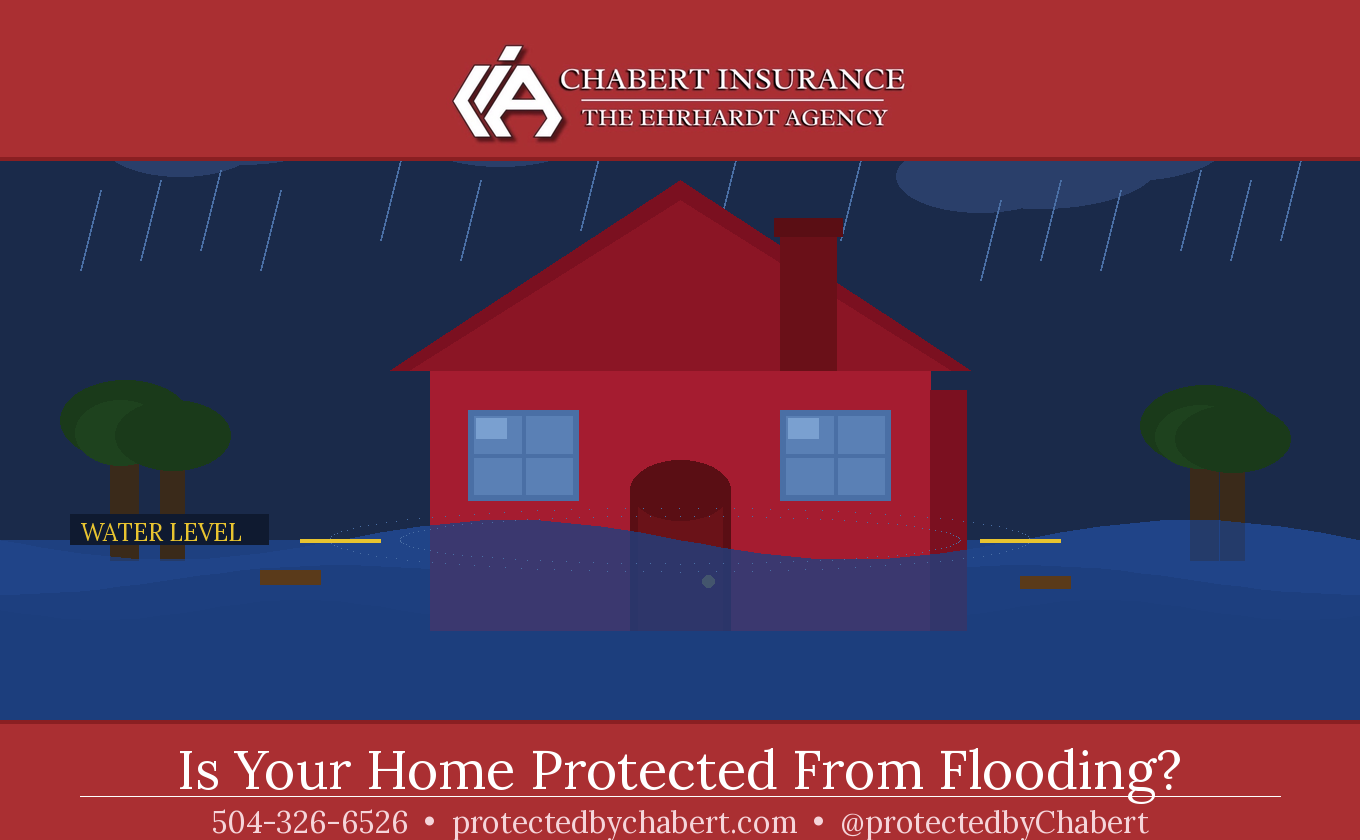
This is the most critical thing every Louisiana homeowner must understand. Your standard homeowners insurance policy does not cover flood damage — period. Flood insurance must be purchased separately, either through the National Flood Insurance Program (NFIP) or through a private flood carrier.

Many homeowners in Mandeville, Covington, and other Northshore communities assume they don’t need flood insurance because they’re “not in a flood zone.” The reality is that over 20% of flood claims come from properties outside of high-risk flood zones. The question isn’t whether you’re in a flood zone — it’s whether you can afford to rebuild without flood coverage.

2. Actual Cash Value vs. Replacement Cost
If your policy pays Actual Cash Value (ACV) instead of Replacement Cost Value (RCV), you could receive significantly less than it actually costs to rebuild after a storm. ACV accounts for depreciation — meaning a 15-year-old roof might only pay out a fraction of what a new roof costs today. With construction costs in Louisiana at historic highs since recent storms, this gap can be devastating.

3. Ordinance or Law Coverage
If your home is damaged and local building codes have changed since it was built, you may be required to bring the entire structure up to current code when rebuilding — not just repair the damaged portion. In older neighborhoods across New Orleans and Metairie, this can add tens of thousands of dollars to a repair bill that your standard policy won’t cover without Ordinance or Law coverage.

4. Wind & Hail Deductibles
Many Louisiana homeowners policies have a separate, higher deductible that applies specifically to wind and hail claims — often 2% to 5% of your home’s insured value. On a $300,000 home, that’s a $6,000 to $15,000 out-of-pocket expense before insurance kicks in. Do you know what your wind deductible is? If you’re not sure, that’s a conversation we need to have before hurricane season.

Your Pre-Hurricane Season Coverage Checklist
Here’s what every homeowner in the New Orleans metro area and Northshore should review before June 1st:

  • Review your homeowners policy dwelling limit — does it reflect what it would actually cost to rebuild your home today?
  • Confirm whether your policy pays Replacement Cost or Actual Cash Value for your dwelling and personal property
  • Check your wind and hail deductible — know your number before a storm forms
  • Review your flood insurance coverage — do you have it? Is the coverage amount adequate?
  • Ask about Ordinance or Law coverage — especially important for homes built before 2000
  • Check your loss of use / additional living expenses coverage — where will you live if your home is uninhabitable after a storm?
  • Review your personal property coverage — do you have a home inventory?
  • Ask about any exclusions specific to your policy or carrier
Don’t Wait Until a Storm Is Named
Insurance carriers routinely place moratoriums on new policies and coverage changes when a named storm enters the Gulf of Mexico. Once a storm is named, it may be too late to add flood coverage, increase your dwelling limit, or make any meaningful changes to your policy. The time to review your coverage is now — not when you’re watching the Weather Channel tracking a Category 3 in the Gulf.

Why Louisiana Homeowners Choose an Independent Agent
Unlike captive agents who can only offer one company’s products, independent agents like Chabert Insurance The Ehrhardt Agency work with multiple carriers to find the right fit for your home and budget. In a market as complex and carrier-depleted as Louisiana’s, this flexibility is invaluable.

We understand the unique challenges of insuring homes in Southeast Louisiana — the coastal exposure, the flood zones, the aging housing stock, the carrier appetite issues. We work with admitted carriers, non-admitted markets, surplus lines carriers, and specialty programs to make sure our clients have options.

Whether you’re a first-time homebuyer in Mandeville trying to understand what coverage you need, a longtime New Orleans homeowner whose carrier just non-renewed your policy, or a real estate investor in Metairie looking for dwelling coverage on rental properties — we’re here to help.

Serving Homeowners Across Southeast Louisiana
Chabert Insurance The Ehrhardt Agency proudly serves homeowners across the Greater New Orleans metro area and the Northshore, including:

  • New Orleans (Orleans Parish)
  • Metairie & Kenner (Jefferson Parish)
  • Mandeville, Covington & Madisonville (St. Tammany Parish)
  • Slidell & Lacombe (St. Tammany Parish)
  • Laplace & Reserve (St. John the Baptist Parish)
  • Gonzales & Prairieville (Ascension Parish)
  • Surrounding Southeast Louisiana communities
Ready to Review Your Coverage Before Hurricane Season? Don’t wait until a storm is named. Contact Chabert Insurance The Ehrhardt Agency today for a free policy review. We’ll make sure your home is protected before hurricane season gets into full swing. 📞 Call or Text: 504-326-6526 🌐 Visit: protectedbychabert.com 📍 Serving Mandeville & New Orleans, Louisiana