
col-md-8 col-sm-8 col-xs-12 Flood Insurance - Blog | Chabert Insurance: The Ehrhardt Agency
Skip to content
Click to Call
Chabert Insurance: The Ehrhardt Agency

240 Dalwill Dr, Suite B
Mandeville, LA 70471

Get Directions
Chabert Insurance: The Ehrhardt Agency

824 Elmwood Park Blvd, Suite 145
New Orleans, LA 70123

Get Directions
Chabert Insurance: The Ehrhardt Agency Blog

FEMA Flood Zones in New Orleans — What Homeowners Need to Know

If you own a home in the Greater New Orleans area or on the Northshore, there is a number attached to your property that affects your mortgage, your insurance premium, and your financial exposure to one of the most common disasters in Louisiana. That number — or more accurately, that letter — is your FEMA flood zone designation.

And yet, most Louisiana homeowners have no idea what their flood zone actually means, how it was determined, or why it matters so much. At Chabert Insurance The Ehrhardt Agency, we talk about flood zones with clients every single day. So let’s clear it up once and for all.

What Is a FEMA Flood Map?

FEMA’s Flood Insurance Rate Maps — known as FIRMs — are the official government maps that show the flood risk for every piece of land in the country. These maps are created using detailed engineering studies, historical flood data, elevation surveys, storm modeling, and drainage analysis.

The maps divide land into flood zones based on the statistical probability of flooding in any given year. Your flood zone designation tells lenders, insurers, and local governments how likely your property is to flood — and at what level.

In Southeast Louisiana, FEMA flood maps cover Orleans Parish, Jefferson Parish, St. Tammany Parish, St. Charles Parish, St. Bernard Parish, and the surrounding areas. The maps are updated periodically as new data becomes available, new levees are built, and development patterns change across the region.

You can look up your property’s official flood zone designation at FEMA’s Flood Map Service Center at msc.fema.gov — just enter your address and your Flood Insurance Rate Map will pull up.

Breaking Down the Flood Zone Designations

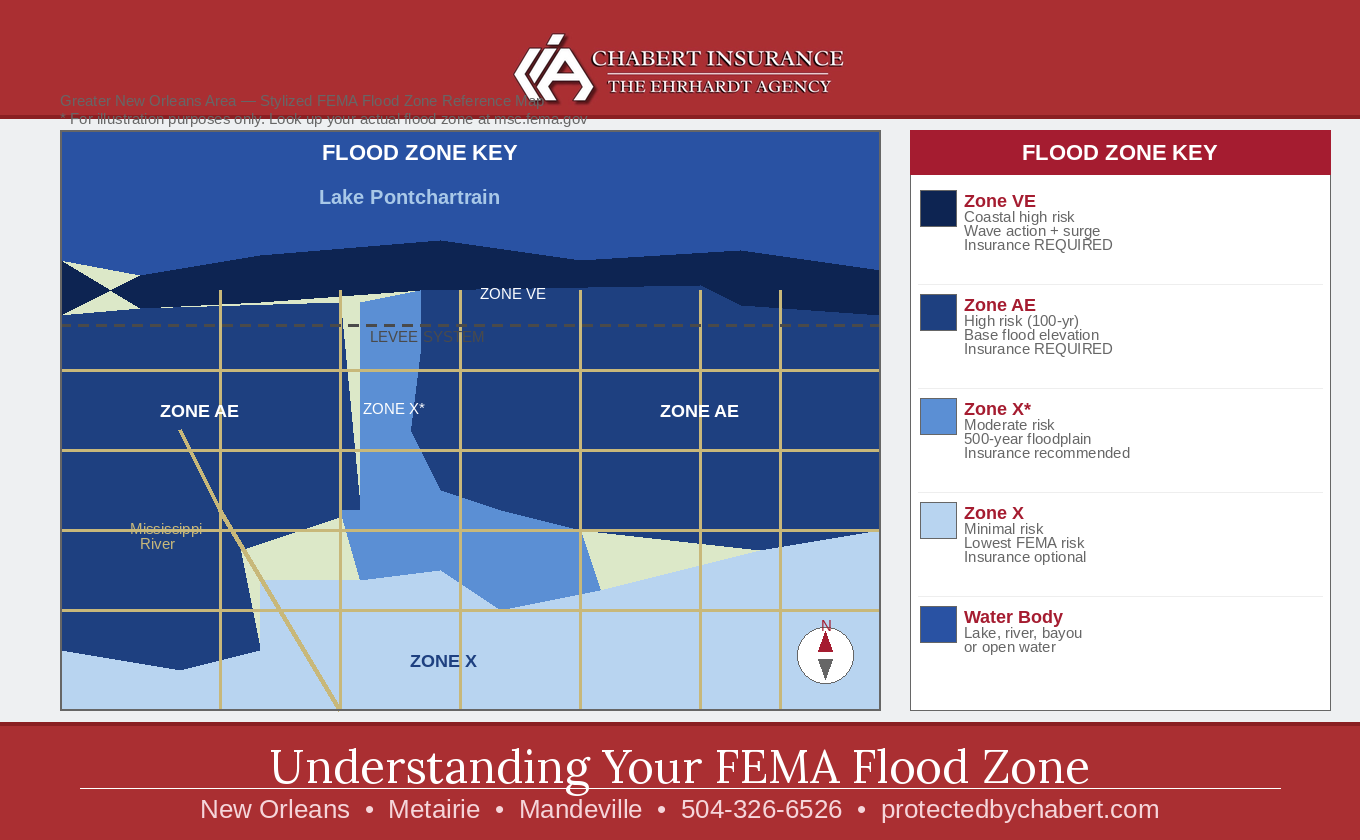
Here is what each flood zone designation actually means for homeowners in the New Orleans metro area and Northshore:

ZoneWhat It MeansFlood Insurance Required?
Zone AEHigh-risk zone. Has a 1% annual chance of flooding (the ‘100-year flood’). Base Flood Elevations are established.Yes — required for federally backed mortgages
Zone AHigh-risk zone. 1% annual chance of flooding but no Base Flood Elevation established.Yes — required for federally backed mortgages
Zone VE / VCoastal high-risk zone subject to wave action in addition to flooding. Most severe designation.Yes — required for federally backed mortgages
Zone X (Shaded)Moderate risk. 0.2% annual chance of flooding (the ‘500-year flood’). Between the 100-year and 500-year floodplain.Not required — but strongly recommended
Zone X (Unshaded)Minimal risk area. Outside the 500-year floodplain. Considered low risk.Not required — but still possible to flood

The ‘100-Year Flood’ — The Most Misunderstood Term in Insurance

When you hear that a property is in the ‘100-year floodplain,’ most people assume it means the area only floods once every hundred years. That is one of the most dangerous misconceptions in the insurance world — and in Louisiana, it can cost you everything.

The 100-year flood designation does not mean a flood happens once a century. It means there is a 1% chance of a flood of that magnitude occurring in any given year. That may sound small, but consider this: over the course of a 30-year mortgage, a home in the 100-year floodplain has roughly a 26% chance of experiencing a flood event.

In Louisiana, where major storms arrive with regularity and drainage infrastructure is constantly tested, the statistical risk is even more meaningful than those numbers suggest. Orleans and Jefferson Parishes have among the highest concentrations of repetitive flood loss properties in the entire country — properties that have flooded not once, not twice, but multiple times.

Being Outside a Flood Zone Does Not Mean You Are Safe

This is perhaps the most important point we make to homeowners across the Northshore and Greater New Orleans area: being outside a high-risk flood zone does not mean your home cannot flood. It simply means FEMA has determined the statistical probability is lower.

The data backs this up clearly. Nationally, roughly 25% of all flood insurance claims are filed by properties located outside of high-risk flood zones. In a state like Louisiana — where heavy rainfall events, overwhelmed drainage systems, and hurricane storm surge routinely affect neighborhoods well outside mapped floodplains — that number is especially relevant.

Think about the flooding that occurred across the Northshore during the August 2016 flood event. Tens of thousands of homes in St. Tammany Parish and surrounding areas flooded — many of them in Zone X, where flood insurance was not required and many homeowners did not have it. The damage was catastrophic precisely because so many people assumed they were safe.

The Hard Truth Being in Zone X or outside a mapped flood zone is not a guarantee that your home will not flood. It is a statistical designation based on modeling — not a promise. Every home in Southeast Louisiana has some level of flood risk. The only question is whether you are financially prepared if it happens.

How Flood Zone Designations Affect Your Insurance and Mortgage

Your flood zone designation has direct, real-world financial consequences. Here is how it affects you:

Federally Backed Mortgages

If your home is in a high-risk flood zone (Zone A, AE, V, or VE) and you have a mortgage backed by a federal lender — which includes most conventional mortgages — you are legally required to carry flood insurance. Your lender will verify this at closing and every year thereafter. If you let your flood policy lapse, your lender can force-place coverage on your behalf, which is almost always far more expensive than purchasing it yourself.

Insurance Premiums

Your flood zone designation is one of the primary factors that determines your flood insurance premium. Properties in Zone AE or VE will typically carry higher premiums than those in Zone X. However, since FEMA introduced Risk Rating 2.0 in 2021 and 2022, flood insurance pricing has shifted to reflect each property’s individual risk characteristics — including elevation, distance from water, and foundation type — rather than relying solely on flood zone designation.

This means that some Zone X properties have seen premium increases under the new system, while some Zone AE properties have seen decreases, depending on their specific risk profile.

Home Sales and Purchases

When you buy or sell a home in Louisiana, the flood zone designation plays a significant role. Buyers in high-risk zones must factor the cost of mandatory flood insurance into their monthly housing budget. Sellers in high-risk zones are required to disclose the property’s flood zone status. And when a property is remapped from a lower-risk zone to a higher-risk zone, it can affect the home’s marketability and value.

What Are FEMA Map Updates — and Why Should You Pay Attention?

FEMA periodically revises flood maps to account for new data, infrastructure changes, and updated storm modeling. In recent years, Southeast Louisiana has seen significant map revisions affecting Orleans, Jefferson, St. Tammany, and St. Charles Parishes — with expanded AE zones in some areas and revised V zones near Lake Pontchartrain reflecting updated wave and surge modeling.

When a map update places your property in a higher-risk zone, it can trigger mandatory flood insurance requirements and affect your premium. When a map update moves your property to a lower-risk zone, you may have the opportunity to reduce your premium or adjust your coverage.

The key takeaway: your flood zone designation today may not be your flood zone designation in five years. Staying informed about map updates in your parish is an important part of managing your risk and your insurance costs as a Louisiana homeowner.

NFIP vs. Private Flood Insurance — Which Is Right for You?

Most flood insurance in Louisiana is purchased through the National Flood Insurance Program — the federal government-backed program administered by FEMA. NFIP policies are available to homeowners, renters, and business owners in participating communities and offer up to $250,000 in building coverage and $100,000 in contents coverage.

However, private flood insurance has grown significantly in recent years and offers some important advantages worth discussing with your agent:

  • Higher coverage limits — private policies can often exceed the NFIP’s $250,000 building cap, which is important for higher-value homes.
  • Additional coverages — some private policies include loss of use coverage and other features not available through the NFIP.
  • Competitive pricing — for lower-risk properties, private flood insurance can sometimes be less expensive than an NFIP policy under Risk Rating 2.0.
  • Shorter waiting periods — some private carriers offer shorter waiting periods than the NFIP’s standard 30 days.

As an independent insurance agency, Chabert Insurance The Ehrhardt Agency can help you compare both NFIP and private flood insurance options to find the right fit for your home and budget.

How to Look Up Your Flood Zone — and What to Do Next

Looking up your flood zone is simple. Here is how:

  • Go to msc.fema.gov — FEMA’s Flood Map Service Center.
  • Enter your property address in the search bar.
  • Your Flood Insurance Rate Map will appear, showing your zone designation.
  • You can also contact your parish floodplain administrator, or simply call us and we can help walk you through what it means.

Once you know your zone, the next step is making sure your coverage is appropriate. If you are in a high-risk zone, your flood coverage limits should reflect the actual cost to rebuild your home — not just meet the mortgage lender’s minimum requirement. If you are in Zone X, we strongly encourage you to consider a flood policy anyway, given Louisiana’s track record with flooding events that go well beyond what any map can predict.

Not Sure What Your Flood Zone Means for Your Coverage? We help homeowners across New Orleans, Metairie, Mandeville, Covington, and the entire Southeast Louisiana area understand their flood risk and make sure their coverage is right. Let’s talk before the next storm season. 📞 Call or Text: 504-326-6526 🌐 Visit: protectedbychabert.com 📍 Mandeville & New Orleans, Louisiana

Is Your Home Ready for Hurricane Season in Louisiana?

Living in Southeast Louisiana means understanding one unavoidable reality: hurricane season is not a matter of if, but when. From New Orleans to Metairie, from Mandeville to the rest of the Northshore, every homeowner in our region needs to ask one critical question before June 1st rolls around each year — is my home truly protected?

At Chabert Insurance The Ehrhardt Agency, we work with homeowners across Jefferson Parish, Orleans Parish, St. Tammany Parish, and beyond to make sure their coverage is ready before a storm ever forms in the Gulf. In this post, we’re breaking down exactly what you need to review — and why waiting until a storm is named is already too late.

Why Hurricane Season Hits Differently in Southeast Louisiana
Louisiana consistently ranks as one of the most hurricane-vulnerable states in the country — and Southeast Louisiana sits right in the crosshairs. The combination of coastal geography, low elevation, aging infrastructure, and our proximity to the Gulf of Mexico means that even a storm that doesn’t make a direct hit can cause catastrophic flooding, wind damage, and extended power outages.

Since Hurricane Katrina in 2005, the Louisiana homeowners insurance market has transformed dramatically. Many national carriers have reduced their footprint or exited the state entirely, leaving homeowners with fewer options and — in many cases — policies they don’t fully understand. That’s exactly where working with a local, independent insurance agent makes all the difference.

As an independent agency, Chabert Insurance The Ehrhardt Agency works with multiple carriers to find the right coverage for your specific home, neighborhood, and risk profile — whether you’re in a high-risk flood zone in New Orleans East, a newer subdivision in Mandeville, or a historic home in Metairie.

The Most Common Coverage Gaps We See in Louisiana Homeowners Policies
After reviewing hundreds of policies across the Greater New Orleans area, here are the gaps we see most often — and the ones that cost homeowners the most when a storm hits:

1. Flood Insurance Is NOT Included in Your Homeowners Policy
This is the most critical thing every Louisiana homeowner must understand. Your standard homeowners insurance policy does not cover flood damage — period. Flood insurance must be purchased separately, either through the National Flood Insurance Program (NFIP) or through a private flood carrier.

Many homeowners in Mandeville, Covington, and other Northshore communities assume they don’t need flood insurance because they’re “not in a flood zone.” The reality is that over 20% of flood claims come from properties outside of high-risk flood zones. The question isn’t whether you’re in a flood zone — it’s whether you can afford to rebuild without flood coverage.

2. Actual Cash Value vs. Replacement Cost
If your policy pays Actual Cash Value (ACV) instead of Replacement Cost Value (RCV), you could receive significantly less than it actually costs to rebuild after a storm. ACV accounts for depreciation — meaning a 15-year-old roof might only pay out a fraction of what a new roof costs today. With construction costs in Louisiana at historic highs since recent storms, this gap can be devastating.

3. Ordinance or Law Coverage
If your home is damaged and local building codes have changed since it was built, you may be required to bring the entire structure up to current code when rebuilding — not just repair the damaged portion. In older neighborhoods across New Orleans and Metairie, this can add tens of thousands of dollars to a repair bill that your standard policy won’t cover without Ordinance or Law coverage.

4. Wind & Hail Deductibles
Many Louisiana homeowners policies have a separate, higher deductible that applies specifically to wind and hail claims — often 2% to 5% of your home’s insured value. On a $300,000 home, that’s a $6,000 to $15,000 out-of-pocket expense before insurance kicks in. Do you know what your wind deductible is? If you’re not sure, that’s a conversation we need to have before hurricane season.

Your Pre-Hurricane Season Coverage Checklist
Here’s what every homeowner in the New Orleans metro area and Northshore should review before June 1st:

  • Review your homeowners policy dwelling limit — does it reflect what it would actually cost to rebuild your home today?
  • Confirm whether your policy pays Replacement Cost or Actual Cash Value for your dwelling and personal property
  • Check your wind and hail deductible — know your number before a storm forms
  • Review your flood insurance coverage — do you have it? Is the coverage amount adequate?
  • Ask about Ordinance or Law coverage — especially important for homes built before 2000
  • Check your loss of use / additional living expenses coverage — where will you live if your home is uninhabitable after a storm?
  • Review your personal property coverage — do you have a home inventory?
  • Ask about any exclusions specific to your policy or carrier
Don’t Wait Until a Storm Is Named
Insurance carriers routinely place moratoriums on new policies and coverage changes when a named storm enters the Gulf of Mexico. Once a storm is named, it may be too late to add flood coverage, increase your dwelling limit, or make any meaningful changes to your policy. The time to review your coverage is now — not when you’re watching the Weather Channel tracking a Category 3 in the Gulf.

Why Louisiana Homeowners Choose an Independent Agent
Unlike captive agents who can only offer one company’s products, independent agents like Chabert Insurance The Ehrhardt Agency work with multiple carriers to find the right fit for your home and budget. In a market as complex and carrier-depleted as Louisiana’s, this flexibility is invaluable.

We understand the unique challenges of insuring homes in Southeast Louisiana — the coastal exposure, the flood zones, the aging housing stock, the carrier appetite issues. We work with admitted carriers, non-admitted markets, surplus lines carriers, and specialty programs to make sure our clients have options.

Whether you’re a first-time homebuyer in Mandeville trying to understand what coverage you need, a longtime New Orleans homeowner whose carrier just non-renewed your policy, or a real estate investor in Metairie looking for dwelling coverage on rental properties — we’re here to help.

Serving Homeowners Across Southeast Louisiana
Chabert Insurance The Ehrhardt Agency proudly serves homeowners across the Greater New Orleans metro area and the Northshore, including:

  • New Orleans (Orleans Parish)
  • Metairie & Kenner (Jefferson Parish)
  • Mandeville, Covington & Madisonville (St. Tammany Parish)
  • Slidell & Lacombe (St. Tammany Parish)
  • Laplace & Reserve (St. John the Baptist Parish)
  • Gonzales & Prairieville (Ascension Parish)
  • Surrounding Southeast Louisiana communities
Ready to Review Your Coverage Before Hurricane Season? Don’t wait until a storm is named. Contact Chabert Insurance The Ehrhardt Agency today for a free policy review. We’ll make sure your home is protected before hurricane season gets into full swing. 📞 Call or Text: 504-326-6526 🌐 Visit: protectedbychabert.com 📍 Serving Mandeville & New Orleans, Louisiana

Flood Insurance Exclusions: Are You Fully Protected in Mandeville, LA?

Flood insurance is a vital safety net for homeowners in Mandeville, LA, where heavy rains and rising waters are all too common. But while flood insurance offers critical protection, it’s important to understand what it doesn’t cover. Knowing the exclusions in your policy can help you avoid surprises when disaster strikes.

What Flood Insurance Doesn’t Cover

Flood insurance policies, including those backed by the National Flood Insurance Program (NFIP), have specific exclusions. For example, damage caused by negligence—such as failing to maintain your property—is not covered. Additionally, outdoor property like landscaping, fences, and swimming pools are excluded. If your car is damaged in a flood, you’ll need separate auto insurance with comprehensive coverage to handle those costs.

Basements and Mold: Common Coverage Gaps

Basement damage is another area where flood insurance falls short. While structural elements like walls and floors may be covered, personal belongings stored in the basement often are not. Mold damage resulting from a flood is also excluded unless it’s directly caused by the event and addressed promptly. These gaps can leave homeowners in Mandeville scrambling to cover repair costs.

How to Protect Yourself

Understanding your policy is key to avoiding surprises. At Chabert Insurance of the Northshore, we help Mandeville homeowners review their flood insurance coverage and explore supplemental options to fill in the gaps. From private flood insurance to additional riders, there are ways to ensure you’re fully protected.

Don’t wait until the next storm to find out what your flood insurance doesn’t cover. Contact Chabert Insurance of the Northshore today to review your policy and make sure you’re prepared for whatever comes your way!

Preparing for Hurricane Season in Mandeville: How Flood Insurance Protects You

Living in Mandeville, LA, means enjoying the beauty of Lake Pontchartrain and the charm of the Northshore. However, it also means facing the annual threat of hurricanes and the flooding they can bring. Hurricane season, which runs from June to November, poses significant risks to homes and businesses in Mandeville. Flood insurance is a critical tool for protecting your property and ensuring you can recover quickly after a storm. Chabert Insurance of the Northshore is here to help you understand the importance of flood insurance and how it can safeguard your future.

Why Hurricane Season Brings Flood Risks to Mandeville

Mandeville’s proximity to Lake Pontchartrain and its low-lying geography make it particularly vulnerable to flooding during hurricanes. Storm surges, heavy rainfall, and overflowing waterways can lead to widespread water damage. Even homes that are not in designated flood zones can experience flooding during severe storms. This unpredictability highlights the importance of having flood insurance, which provides coverage for damages caused by rising water.

While standard homeowners insurance policies cover wind damage, they typically exclude flood-related losses. Flood insurance is a separate policy designed to fill this gap, ensuring Mandeville residents are fully protected during hurricane season.

How Flood Insurance Works During Hurricanes

Flood insurance covers a wide range of damages caused by rising water, including:

  • Structural Damage: Repairs to walls, floors, and foundations affected by floodwaters.
  • Personal Belongings: Replacement of furniture, electronics, and other items damaged by flooding.
  • Cleanup Costs: Expenses related to removing debris and drying out your property.
  • Temporary Living Expenses: Assistance with housing costs if your home becomes uninhabitable.

Chabert Insurance of the Northshore offers flood insurance policies tailored to the unique needs of Mandeville residents, ensuring you’re covered when disaster strikes.

Steps to Prepare for Hurricane Season

In addition to securing flood insurance, there are several steps Mandeville residents can take to prepare for hurricane season:

  • Create an Emergency Plan: Establish evacuation routes, communication plans, and a checklist of essential items.
  • Stock Up on Supplies: Keep a hurricane kit with water, non-perishable food, flashlights, batteries, and first-aid supplies.
  • Secure Your Property: Install storm shutters, reinforce doors, and elevate valuable items to reduce flood damage.
  • Stay Informed: Monitor weather updates and follow guidance from local authorities during storms.

By combining these proactive measures with comprehensive flood insurance, you can minimize the impact of hurricanes on your home and family.

Why Mandeville Residents Need Flood Insurance

Many Mandeville homeowners assume they don’t need flood insurance if they’re not in a high-risk flood zone. However, FEMA reports that more than 20% of flood claims come from properties outside of these zones. Hurricanes can cause flooding in unexpected areas, making flood insurance a smart investment for all residents.

Chabert Insurance of the Northshore, located in Mandeville, LA, specializes in helping homeowners and businesses find the right flood insurance policy for their needs. With our expertise, you can feel confident that your property is protected during hurricane season.

Protect Your Home Before the Next Storm

Hurricane season is unpredictable, but your preparedness doesn’t have to be. Flood insurance provides peace of mind and financial security, allowing you to recover quickly after a storm. Chabert Insurance of the Northshore is proud to serve the Mandeville community, offering flood insurance policies that keep you covered when it matters most. Visit Chabert Insurance today to learn more about how we can help you prepare for hurricane season.

What is the Role of a Public Adjuster in a Flood Insurance Claim in Mandeville, LA?

Filing a flood insurance claim after a disaster can be a complex process. In Mandeville, LA, where floods are a common occurrence, understanding the role of a public adjuster in your flood insurance claim can be beneficial. At Chabert Insurance of the Northshore, we’re here to help you navigate this process.

The Role of a Public Adjuster

A public adjuster is a professional who can help you with your insurance claim. They work for you, not the insurance company, and their goal is to help you get the maximum payout on your claim. They can assess the damage, help you understand your policy, and negotiate with the insurance company on your behalf.

Why Hire a Public Adjuster?

Hiring a public adjuster can be particularly beneficial if you have a large claim, or if the damage is complex and difficult to assess. They have the expertise to accurately estimate the cost of repairs and can help ensure you’re not overlooking any eligible damage. They can also save you time and stress by handling the negotiations with the insurance company.

How to Find a Public Adjuster

When looking for a public adjuster, it’s important to do your research. Look for someone with experience in flood insurance claims, and check their references and credentials. It’s also a good idea to interview a few different adjusters to find one you feel comfortable with.

At Chabert Insurance of the Northshore in Mandeville, LA, we’re committed to helping you understand your flood insurance coverage and the claims process. Contact us today to learn more about how a public adjuster can help with your flood insurance claim.

How Can I Get Flood Insurance?

Standard home insurance doesn’t cover damage from floods. If you live in a high-risk flood area, you may benefit from a flood insurance policy that would pay for repair and replacement in the event of a flood. Many private insurance carriers do not offer flood insurance.

Instead, flood insurance is provided through the National Flood Insurance Program. At Chabert Insurance of the Northshore, servicing Mandeville, LA, we can help you get flood insurance if you need it. Here’s what you need to know. 

Find A Good Insurance Agent

Getting an insurance policy through the National Flood Insurance Program starts with finding a good insurance agent. When you’re looking for an insurance agent, consider the following:

  • Communication. Does the insurance agent communicate with you clearly about insurance products to help you make informed decisions when shopping for insurance? 
  • Listening. Does the insurance agent listen to you about your budget and other considerations to help you find the right insurance product for your needs?
  • Dependability. Does the insurance agent return phone calls, get back to you quickly when you have a question, and does the agent do what they say they’ll do?

Finding the right insurance agent can help ensure that you’ll get the best policy for your needs and that if you ever need help with your flood policy, your agent will be there to offer that help. 

Read the Policy

Once your insurance agent can provide you with a flood insurance policy, review it carefully to ensure that it offers the level of coverage you need to be safe. Call Chabert Insurance of the Northshore, servicing Mandeville, LA, to learn more.