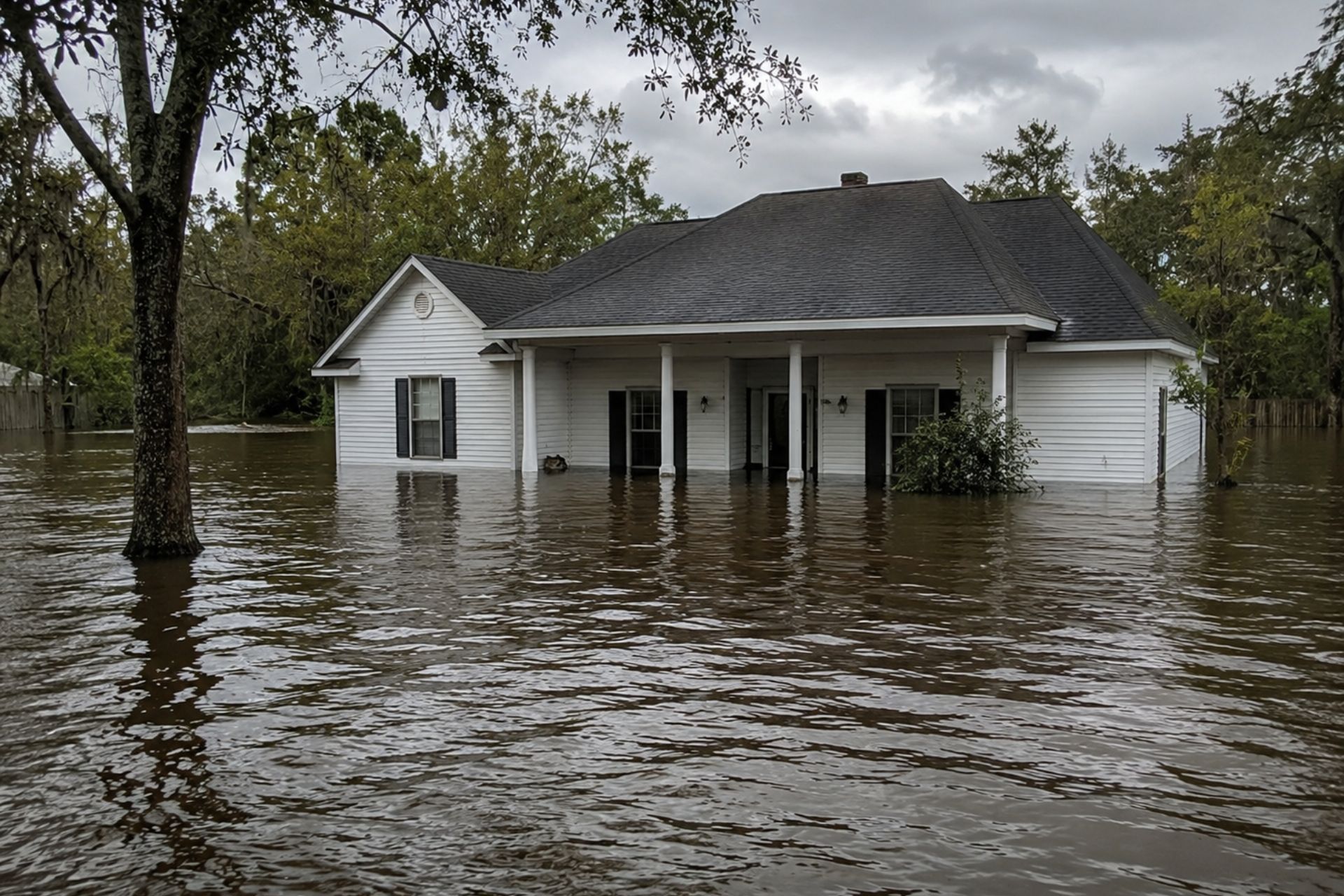

Flooding is the most common and costly natural disaster in the United States, yet standard homeowners policies don't cover it. If you own property in New Orleans, Mandeville, or anywhere along Louisiana's Gulf Coast, you've likely weighed the federal flood program against a private policy. The differences between these two options affect how much protection you actually carry, how quickly coverage kicks in, and whether you'll have a roof over your head while your home dries out. Choosing between the NFIP and private flood insurance means understanding the specifics: coverage caps, waiting periods, how your belongings are valued, and the situations where one option clearly outperforms the other. For Louisiana homeowners especially, this decision has real financial consequences. A single flood event can cause tens of thousands of dollars in damage, and the wrong policy can leave you covering a painful gap out of pocket. The federal program has been the default for decades, but private carriers have expanded their offerings significantly in recent years. That expansion gives you more choices, but it also means more homework. This guide breaks down each critical difference so you can match the right policy to your property, your budget, and your risk.
Understanding Your Flood Insurance Options
The Role of the National Flood Insurance Program (NFIP)
The NFIP has been the backbone of flood coverage in the United States since 1968. Administered by FEMA, it provides standardized policies through a network of insurers and agents. The program was designed to fill a gap that private insurers wouldn't touch at the time: covering properties in flood-prone areas where the risk was simply too high for traditional underwriting.
Today, the NFIP insures roughly five million policies nationwide, with Louisiana consistently ranking among the top states for policy counts. The program's biggest advantage is availability. If your community participates in the NFIP, you can get a policy regardless of your flood zone or claims history. That universal access matters in a state where entire neighborhoods sit below sea level.
The Rise of Private Flood Insurance Markets
Private flood insurance has grown dramatically since federal legislation in 2012 and 2019 made it easier for private carriers to compete. These companies use their own risk models, which sometimes produce lower premiums for properties the NFIP rates conservatively. Private carriers can also offer coverage structures the federal program simply doesn't allow.
In Louisiana, private flood options have become increasingly competitive, particularly for homes in moderate-risk zones or properties with values exceeding NFIP limits. The catch is that private carriers can also decline to insure high-risk properties, and their financial backing depends on reinsurance markets rather than the U.S. Treasury. For some homeowners, that trade-off is worth it. For others, the federal program's stability wins out.
Comparing Coverage Limits and Protection Scopes
Building and Contents Caps: The NFIP Ceiling
The NFIP maintains rigid residential coverage caps of $250,000 for buildings and $100,000 for contents. Those numbers haven't changed in years, even as home values and replacement costs have climbed steadily. If your home is worth $400,000 and you carry an NFIP policy, you're self-insuring the gap between $250,000 and your actual rebuild cost.
For commercial properties, the caps are higher: $500,000 for the building and $500,000 for contents. But residential policyholders are stuck with limits that don't reflect the reality of 2026 construction costs, especially in markets like New Orleans where labor and materials run high.
Excess Coverage and High-Value Assets in Private Policies
Private flood insurers can set their own limits, and many offer coverage well above the NFIP ceiling. Policies with $1 million or more in building coverage are available for homes that need it. This is a major advantage for owners of higher-value properties along Lake Pontchartrain or in historic neighborhoods where rebuild costs are substantial.
Private policies also tend to be more flexible with what they cover. Some include pool equipment, detached structures, and landscaping that the NFIP excludes. If you own expensive personal property like art, electronics, or custom finishes, a private policy can often be structured to cover those items more completely.
NFIP vs. Private Flood: Quick Comparison Table
| Feature | NFIP | Private Flood Insurance |
|---|---|---|
| Max Building Coverage | $250,000 (residential) | $1M+ available |
| Max Contents Coverage | $100,000 (residential) | $500K+ available |
| Waiting Period | 30 days (standard) | 0-14 days (varies) |
| Contents Valuation | Actual Cash Value | Replacement Cost (common) |
| Loss of Use / ALE | Not included | Often included |
| Availability | Guaranteed in participating communities | Subject to underwriter approval |
| Backed By | U.S. Treasury / FEMA | Private reinsurance markets |
| Basement Coverage | Very limited | Varies; often broader |
This comparison highlights why the choice between federal and private flood coverage depends so heavily on your specific property and financial situation.
Waiting Periods and Timing Your Purchase
The Standard 30-Day NFIP Wait
NFIP policies come with a standard 30-day waiting period before coverage takes effect. You can't buy a policy on Monday and expect it to cover a storm on Tuesday. The logic behind this rule is to prevent people from purchasing coverage only when a hurricane is bearing down on their area.
There are a few exceptions. If you're buying or refinancing a home and your lender requires flood insurance, coverage can start at closing. Certain map revision scenarios also allow for a shorter wait. But for most voluntary purchases, you're looking at a full month of exposure before your policy activates.
Private Market Speed: 0 to 14 Day Windows
Private carriers set their own waiting periods, and many offer windows significantly shorter than the NFIP's 30 days. Some policies take effect in as few as 10 days, and a handful of carriers offer coverage with no waiting period at all for certain qualifying purchases.
This flexibility matters in Louisiana, where hurricane season runs from June through November and weather patterns can shift quickly. If you've been putting off a flood policy and suddenly realize you need one, a private carrier may be your only option for near-term protection. That said, the smartest move is always buying well before you need it.
How Contents and Living Expenses Are Treated
Replacement Cost vs. Actual Cash Value
One of the most significant differences between federal and private flood coverage is how your belongings are valued after a loss. The NFIP pays contents claims on an actual cash value basis, meaning depreciation is factored in. Your five-year-old couch isn't reimbursed at what a new one costs; it's paid out at what a used five-year-old couch is worth.
Many private flood policies offer replacement cost coverage for contents, which pays to replace damaged items with new equivalents. The difference can be thousands of dollars on a single claim. If you've furnished your home with quality pieces or have expensive electronics, replacement cost coverage closes a gap that NFIP policyholders often don't realize exists until they file a claim.
Loss of Use and Additional Living Expenses (ALE)
The NFIP does not cover additional living expenses. If floodwaters make your home uninhabitable, the federal program won't pay for your hotel, temporary rental, or meals while you're displaced. For families in New Orleans who've lived through major flood events, this gap is painfully familiar.
Private flood policies
frequently include loss of use or ALE coverage as a standard feature or optional add-on. This benefit covers temporary housing, food, and other necessary expenses while your home is being repaired. Given that flood damage restoration can take weeks or months, ALE coverage alone can justify choosing a private policy over the NFIP.
When a Private Policy Beats the Federal Program
A private flood policy is the stronger choice in several specific situations. If your home's replacement cost exceeds $250,000, the NFIP simply can't cover you fully. Properties in the $350,000 to $800,000 range across Mandeville and New Orleans are common, and those homeowners face a real coverage gap under the federal program.
Private coverage also wins when you want replacement cost on your contents, need ALE protection, or own a property with features the NFIP excludes: finished basements, detached garages, or outdoor structures. Louisiana homeowners with higher-value properties often find private premiums competitive with NFIP rates, especially if their elevation certificates or flood mitigation efforts reduce their risk profile.
The NFIP still holds an edge for properties in the highest-risk zones where private carriers may decline coverage or charge steep premiums. It's also the safer bet if you value the federal government's financial backing over a private insurer's reinsurance structure. Working with a local agency like Chabert Insurance: The Ehrhardt Agency helps you compare both options side by side with quotes tailored to your specific property and flood zone.
Common Questions About Flood Insurance
Does my homeowners policy cover flooding? No. Standard homeowners insurance excludes flood damage entirely. You need a separate flood policy, either through the NFIP or a private carrier.
Can I have both an NFIP policy and a private flood policy? You can carry an NFIP policy and a separate excess flood policy to extend your limits beyond the federal caps. You generally can't have two primary flood policies on the same property.
Will my mortgage lender accept a private flood policy? Most lenders accept private flood insurance as long as the policy meets certain federal requirements. Confirm with your lender before switching from an NFIP policy.
Is flood insurance required outside high-risk zones? Lenders only mandate flood insurance in Special Flood Hazard Areas (zones starting with A or V). But roughly 25% of flood claims come from moderate and low-risk zones, so coverage is still smart even if it's not required.
How much does private flood insurance cost compared to the NFIP? It depends on your property's risk profile. Some homeowners save 20-30% with private carriers, while others find the NFIP cheaper. The only way to know is to get quotes for both.
Can a private insurer cancel my policy mid-term? Private carriers can choose not to renew at the end of your term, but mid-term cancellations are rare and typically only happen for non-payment or misrepresentation.
Making the Right Choice for Your Property
The decision between NFIP and private flood insurance isn't one-size-fits-all. Your home's value, location, flood zone, and personal financial situation all factor into which policy gives you the best protection per dollar spent. Louisiana homeowners face unique risks that make this choice especially consequential.
If your home is valued near or below the NFIP limits and sits in a high-risk zone, the federal program's guaranteed availability and government backing may be your best fit. If you own a higher-value property, want replacement cost on contents, or need living expense coverage during displacement, a private policy likely serves you better.
The team at Chabert Insurance: The Ehrhardt Agency works with homeowners across New Orleans and Mandeville to evaluate both federal and private flood options based on your property's specific risk profile. Getting personalized quotes for both types of coverage is the most reliable way to make a confident decision before the next storm season arrives.

About the Author
Ryan J. Ehrhardt
Owner / Licensed Agent
I'm Ryan J. Ehrhardt, owner and licensed agent at Chabert Insurance: The Ehrhardt Agency. I lead our team across our Mandeville and New Orleans offices, and I work with families and business owners every day to find coverage that fits their lives. I believe insurance should be simple to understand, so I take the time to explain your options in plain language before you decide.
As an independent agent, I answer to you, not to a single carrier. That means I can shop your policy across many companies and focus on what protects you best. When you call our office, you reach a real person who knows your account. I would be glad to review your coverage and help you feel confident about it.
Recent Posts